
ezyZip Research Benchmarks 42 Archive Formats Spanning Four Decades in a Fully Reproducible Open Study
FOR IMMEDIATE RELEASE
A new study compresses one realistic home folder with 42 archive formats from 1984 to 2026. The practical winner is 7-Zip, whose maximum setting shrinks the folder to 60% of its original size in about four seconds. Beyond that, extreme compressors trade whole minutes for a few more percent
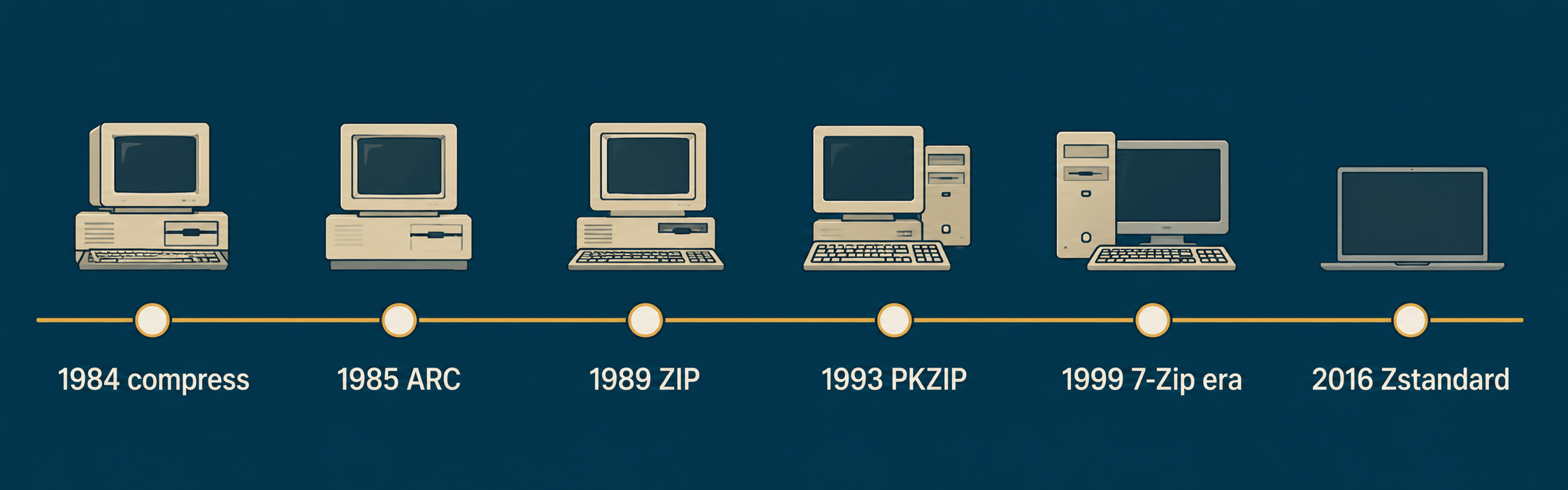
TALLINN, Estonia (July 2026) - WebbyAppy OÜ, the company behind the browser-based archive manager ezyZip, has published the most comprehensive practical comparison of archive formats to date. The benchmark covers 42 archive and compression formats spanning four decades, from 1984's Unix compress and 1985's BBS-era ARC to today's Zstandard and the experimental context-mixing compressor paq8px. The entire study, including the test corpus, benchmark harness, raw results and academic write-up, is published as an open, reproducible repository on GitHub.
Where existing compression benchmarks measure codecs on specialist corpora, the new study asks the question an ordinary computer user actually faces: which format produces the smallest file out of a typical folder, using only the settings a non-expert would touch? Every tool was run at its out-of-the-box defaults and at its single "maximum compression" setting, and nothing else was tuned. Every archive was extracted and verified byte-for-byte against the original files with SHA-256 checksums before its result counted.
One Home Folder, Forty-Two Formats
The test corpus is a realistic 55 MB "home folder" of text, office documents, photos and video. Against it, the study lined up mainstream formats (ZIP, 7-Zip, RAR, tar.gz), modern codecs (Zstandard, Brotli, xz, lz4, zpaq), vintage formats (ARC, ARJ, LHA, zoo, Unix compress), macOS-native containers (Apple Archive, compressed DMG), and imaging formats (SquashFS, WIM, ISO). A final tier of Windows-only and DOS-only archivers, including WinACE, UHARC, KGB, FreeArc, ALZip and StuffIt, no longer runs on a modern Mac at all; the study resurrected these under the Wine compatibility layer and DOSBox emulation so they could take part.
What the Study Found
| Need | Format | Size vs. original | Compression time |
|---|---|---|---|
| Universal compatibility | ZIP | 82% | ~1.5 s |
| Best size/speed balance | 7-Zip (.7z), maximum | 60% | ~4 s |
| Modern open-source alternative | Zstandard (.tar.zst), maximum | 61% | ~7 s |
| Smallest file, full corpus | zpaq, maximum | 56% | ~150 s |
| Smallest single result (text only) | paq8px, maximum | 17.76% | ~19 min |
Archive size as a percentage of the original data (lower is smaller), on the full 55 MB corpus. The exception is paq8px, which was measured on the study's 11 MB text category. Its 17.76% is the smallest result any format achieved on any category, in an archive only paq8px itself can open.
The practical headline is one of diminishing returns. ZIP, the format behind the built-in "compress" command on Windows and macOS, reduced the folder to 82% of its original size. 7-Zip's maximum setting reached 60% in about four seconds, with the open-source Zstandard close behind at 61%. Further gains get expensive. The journaling context-mixing archiver zpaq produced the smallest full-corpus archive at 56%, but needed roughly 150 seconds to compress and about as long again to extract.
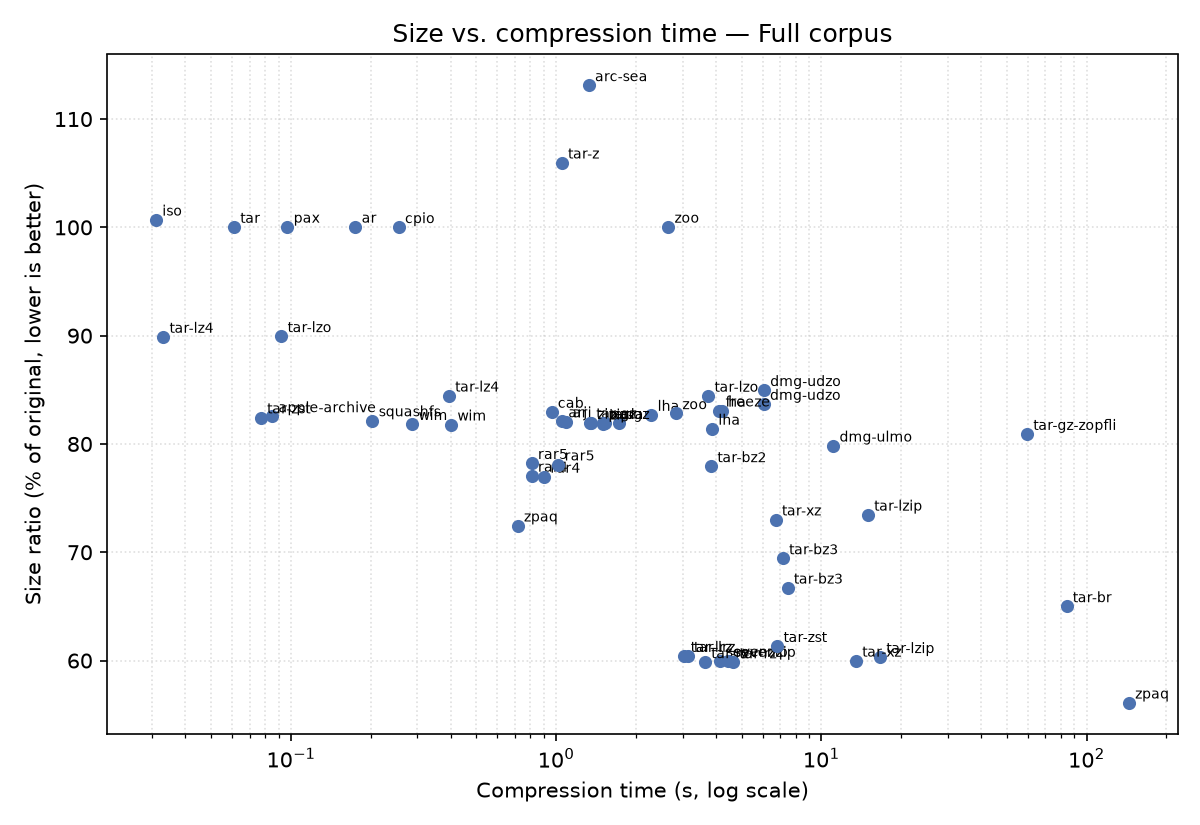
Two findings matter most for everyday users. Office documents barely compress with ZIP, because modern .docx and .xlsx files are already ZIP archives internally; ZIP left them at 99%, while 7-Zip, which compresses across the files in an archive rather than one at a time, squeezed the same documents to 60%. Photos and video proved near-incompressible for every format in the study, at roughly 98% to 100% of their original size. Archiving media is about bundling and integrity, not saving space.
The Smallest File in the Study
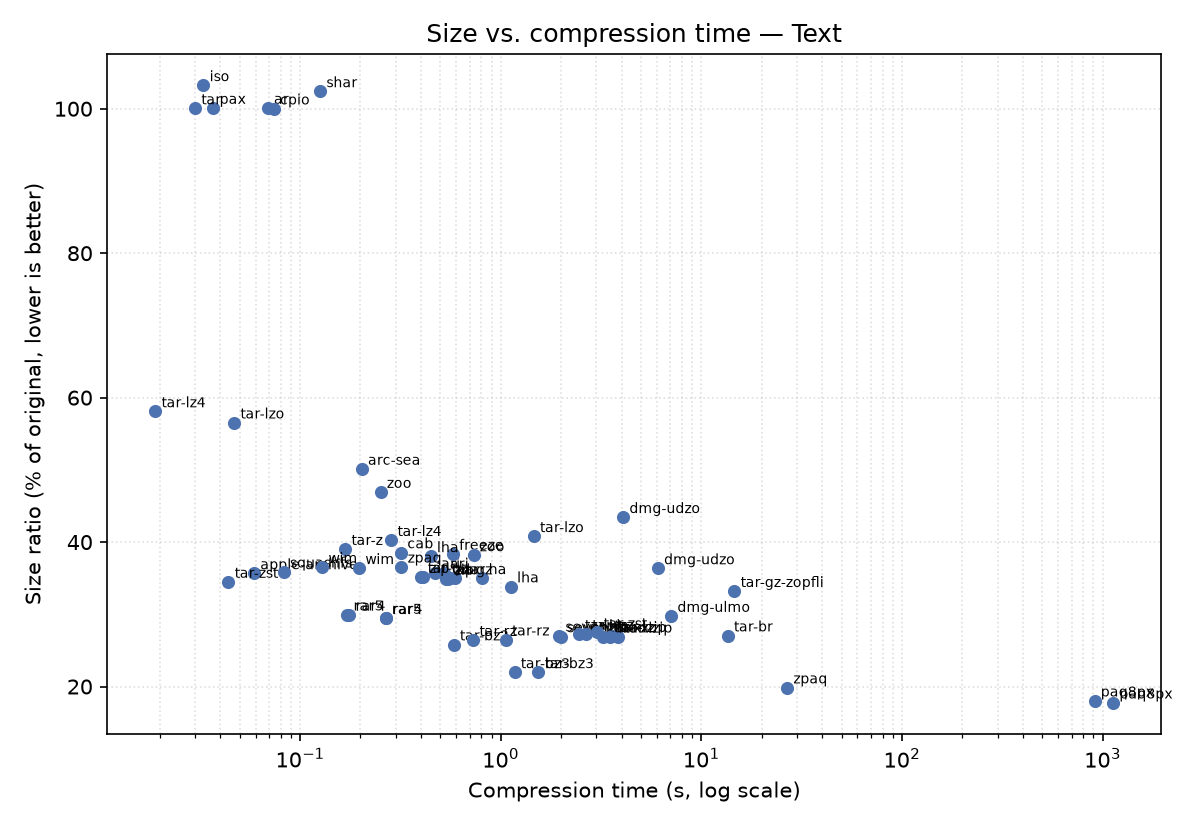
At the extreme end sits paq8px, a state-of-the-art context-mixing compressor. On the study's text category it achieved 17.76% of original size, the smallest result any format recorded on any category. The cost is severe. At a throughput near 12 kilobytes per second, it needed roughly fifteen to nineteen minutes to compress 11 MB of text, as long again to decompress, and it produces an archive only paq8px itself can open. The best mainstream tools reached about 27% on the same data in well under a second.
A 1993 PKZIP Still Works. Some 2000s Archivers Don't.
The study also produced an unplanned finding about format longevity. A PKZIP 2.04g binary from 1993, run inside DOS emulation, still produced ZIP archives that today's tools open without complaint. Its 35.5% result on the text category is nearly identical to the 35% a current ZIP tool achieves. The ZIP format a casual user gets today is essentially the one from three decades ago.
Some far younger software could not finish the course. The 2000s Windows-only archivers FreeArc and UHARC deadlocked under the Wine compatibility layer on a modern Apple Silicon Mac and never completed a run. In the study's words, a 40-year-old open DOS format proved more durable than a 20-year-old proprietary Windows one. It is a practical argument for keeping long-term archives in open, widely implemented formats.
"We finally answered the question users ask us all the time: does the fancy format actually make a smaller file, and is it worth the wait?" said Ezriah Zippernowsky, spokesmonkey for ezyZip. "For most people the answer is wonderfully boring. 7-Zip at maximum gets you nearly all the gain in about four seconds, and after that you are trading whole minutes for a percent or two, which is a long time to hold a banana. The part that makes me hoot is the time travel. A 1993 PKZIP running in a DOS emulator still makes ZIPs any modern computer opens, while two flashy Windows archivers from the 2000s couldn't finish the course at all. Open formats age well. Bananas don't."
Create and Open These Formats in the Browser
The formats the study recommends can all be created directly in a web browser with ezyZip, with no software to install. ZIP covers universal compatibility, 7Z gives the best size-for-speed result, and TAR.ZST is the leading open-source alternative. All of the benchmarked formats, including vintage ones such as ARC, ARJ, LHA and zoo, can be extracted in the browser with ezyZip's online extractor.
Transparency and Reproducibility
The study was conceived, funded and conducted by ezyZip Research, the research activity of WebbyAppy OÜ, and the accompanying paper carries a full funding and competing-interests disclosure. Every number in the study is computed mechanically from the committed test corpus and raw per-run results, and the whole benchmark can be reproduced with a single command from the public repository. The full academic write-up, "The Ultimate Archive Format Comparison: A Reproducible Benchmark of Forty-Two Compression Formats Spanning Four Decades", is available as a PDF in the repository.
About ezyZip
ezyZip is a free online archive manager developed by WebbyAppy. The platform allows users to create, extract, and convert archive files directly in their web browser without uploading files to external servers. Operating since 2009, ezyZip supports over 140 archive formats and is used by millions of people each month worldwide. ezyZip is available at www.ezyzip.com.
About WebbyAppy
WebbyAppy is a fully remote software development company, registered in Australia and Estonia. The company specialises in web-based productivity tools and digital marketing services. Its research activity, ezyZip Research, publishes open, reproducible studies on archiving and compression.